
Famous South African Artists: A Collector's Guide to the Blue Chip Masters
Who are the famous South African artists worth collecting? A collector's guide to the blue chip masters — Stern, Pierneef, Kentridge, Preller, Boonzaier, Boshoff and Van Heerden — and what separates a strong example from an ordinary one.
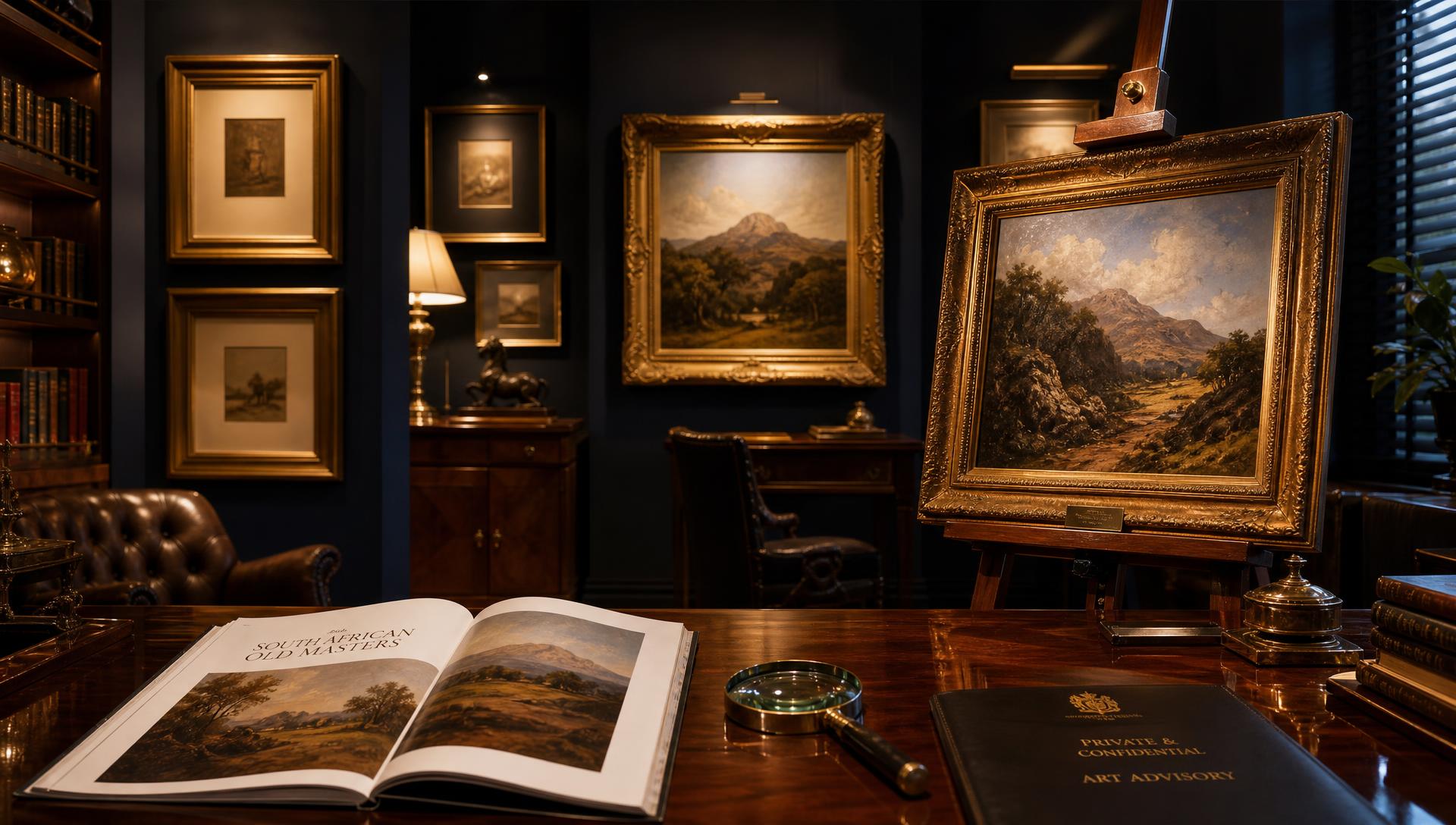
Search for famous South African artists and you will find dozens of names. But for a collector, a much shorter list matters: the artists whose work has proven, over decades, to hold cultural importance and market value. These are the blue chip masters — the names that anchor serious collections, appear in museum holdings, and attract committed buyers whenever strong examples reach the market.
This guide introduces the artists we handle most often at The Blue Chip Room, and — just as importantly — explains what separates an exceptional example of their work from an ordinary one. Because in art, the name on the signature is only the beginning of the conversation.
Irma Stern (1894–1966)
South Africa's most celebrated modernist and, for many years, the record-holder for the highest price paid for a South African painting. Stern trained in Germany under the Expressionists, and her powerful portraits, Congo and Zanzibar subjects, and lush still lifes combine European modernism with an unmistakably African sensibility. What to look for: strong early and mid-period works, Congo and Zanzibar subjects, documented exhibition history, and works illustrated in the literature.
J.H. Pierneef (1886–1957)
The definitive painter of the South African landscape. Pierneef reduced the Highveld, bushveld and dramatic skies to ordered, monumental forms — flat-topped trees, stacked clouds, geometric mountains. His Johannesburg Station Panels remain among the most famous images in South African art. What to look for: commanding Highveld compositions, characteristic trees, good scale and period. His linocuts and works on paper offer an accessible entry point, though edition, rarity and condition remain decisive. We covered his market in detail in our Pierneef market guide.
William Kentridge (b. 1955)
The most internationally recognised living South African artist, represented in the collections of MoMA, Tate and the Centre Pompidou. Kentridge's charcoal drawings, animated films, prints and tapestries engage with history, memory and Johannesburg itself. What to look for: strong drawings related to his major film and theatre projects, early prints in good condition, and works with clear provenance. His international institutional standing gives his market unusual depth and resilience.
Alexis Preller (1911–1975)
A singular imagination in South African art. Preller fused African imagery, mythology, masks and dreamlike symbolism into a visual language that resisted easy categorisation during his lifetime — and commands intense loyalty among collectors today. What to look for: major oils from his strongest periods, subjects drawn from his personal mythology, and impeccable provenance. Top examples are rare and fiercely contested when they appear.
Gregoire Boonzaier (1909–2005)
A founding figure of the New Group and a pillar of Cape painting, Boonzaier is loved for his District Six scenes, Cape Malay quarter views, landscapes and still lifes. His market is broad and deep, with consistent demand across price levels. What to look for: strong Cape scenes with architectural character, vibrant still lifes, and good period. Quality within his large output varies, so selection matters.
Adriaan Boshoff (1935–2003)
A self-taught painter of extraordinary technical gift, Boshoff worked in an impressionistic idiom — landscapes, village scenes, cattle, and intimate figures of women and children — that has earned him a devoted collecting base and one of the strongest secondary markets of any later South African artist. What to look for: accomplished figural and landscape compositions with confident brushwork, good scale, and works from his mature period. Demand for quality examples consistently exceeds supply.
Piet van Heerden (1924–1996)
A painter of quiet, contemplative power, Van Heerden's restrained palettes and dignified still lifes and figures have attracted growing attention from serious collectors. His market has strengthened steadily as supply tightens. What to look for: mature-period works in good condition, characteristic muted compositions, and clear provenance. He remains, in our view, undervalued relative to his quality.
What 'blue chip' actually means in South African art
A blue chip artist is not simply a famous one. The label rests on four foundations: sustained demand across decades, not seasons; representation in major museum and institutional collections; a body of scholarly literature and catalogue documentation; and a secondary market deep enough that strong works can be placed when it is time to sell. Every artist above meets those tests. Many other talented artists meet some of them — which is exactly where advisory judgement earns its keep.
The golden rule: buy the example, not the signature
Two works by the same master can differ enormously in quality and value. Subject, period, scale, condition, provenance and freshness to the market all matter more than the name alone. The best collectors ask of every work: is this the artist at their best, is the history credible, is the price supported by genuinely comparable sales — and would I still be proud to own it if the market paused for five years?
Where to begin
Start with the strongest single work you can responsibly afford rather than several weaker ones, insist on documentation before money changes hands, and take advice from someone whose interest is aligned with yours. If you would like guidance on acquiring — or discreetly placing — works by any of these masters, The Blue Chip Room advises private collectors from Sandton on the secondary market. Browse our current works or contact us in confidence.