
Buying Art in Sandton: How a Private Art Advisory Actually Works
Buying art in Sandton doesn't have to mean walking into a gallery and hoping for the best. How a private advisory sources, vets and prices blue chip works — and when one is worth using.
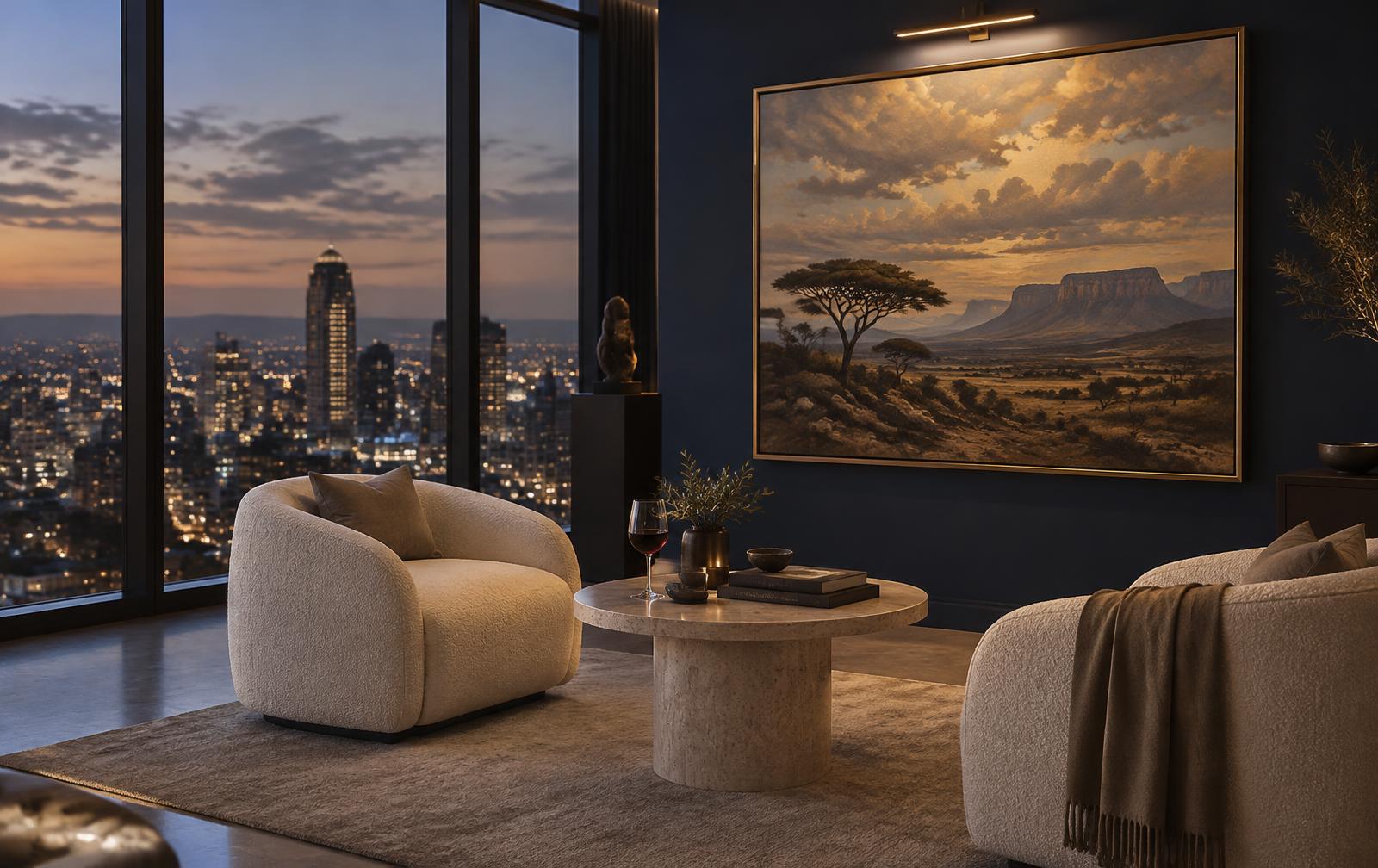
Most of the art that changes hands in Johannesburg never appears on a gallery wall. It moves between collectors, through estates, and along private introductions. This is the secondary market — and if you are buying in Sandton and only looking at what is currently on display, you are seeing a small fraction of what is actually available.
This is the first post in a short series on buying art in Sandton: how the local market really works, what to look for, and how to buy with confidence. We start with the question collectors ask us most often — what does a private advisory actually do, and when is one worth using?
What a private advisory does — and what it doesn't
An advisory is not a gallery. A gallery sells its own inventory: what it has, when it has it, at the price it has set. An advisory works the other way round. It starts with you — what you like, the space you are living with, the budget you are comfortable with, and whether you would still be glad to own the work in ten years. Then it goes to find the right piece, from wherever in the market it happens to sit: another collector, an estate, a dealer, or an auction room.
In practice that comes down to three jobs. Search, which is quiet — by the time you see a shortlist, several conversations have already happened and most of what came back has been ruled out. Vetting, which is documented rather than assumed. And price discipline, the step most buyers skip and the one that costs the most money.
Why the secondary market matters to Sandton buyers
The primary market is a living artist's work sold for the first time. The secondary market is everything after that first sale. For the blue chip South African names — Pierneef, Stern, Kentridge, Preller, Boonzaier, Boshoff, Van Heerden — the secondary market is where almost all the supply sits, because those artists are no longer producing. If you want a particular master, someone already owns the work. The only real question is whether they can be persuaded to part with it.
That is also what makes the secondary market attractive. Works surface at prices that no fixed price list would produce: an estate being settled, a collection being rationalised, a seller who simply wants the matter resolved. Those situations create openings. They also create risk, which is the next section.
What to check before any money moves
Four things, in this order. Authenticity, and how it is documented — a certificate, a catalogue raisonné entry, a signed photograph, an artist's stamp. Provenance, meaning the chain of ownership from the artist's hands to today. Condition, ideally as a written report rather than a glance across a room, because restoration, relining, fading and frame history all move value. And market evidence: comparable sales of genuinely similar works, not asking prices. Asking prices are what sellers hope. Records are what buyers paid.
We set the full checklist out in our post on provenance and authenticity — read it before your next viewing. And if you would like the documentation on a specific work we are handling, ask. It should be provided before you commit, not after.
How the fee works
There are two models. A buyer's fee, agreed in writing before the search begins, paid for the work done on your behalf. Or an arrangement where the advisory is paid by the seller — legitimate enough, provided you always know who is paying and whose interest the advice serves. We publish our fees openly rather than leaving them to be discovered late, because a relationship that starts with an unclear number rarely ends well.
When you don't need an advisory
If you are buying one modest work you have already seen, from an established gallery, at a fair price — buy it, and enjoy it. You don't need anyone. Advisory value shows up when the work is significant, when the seller is not a shop, when the figure runs into six or seven digits, when provenance has to be reconstructed, or when you are selling and would rather not announce it. In those situations the cost of a single mistake dwarfs the fee.
What a first conversation looks like
No obligation and no showroom tour. You tell us what you hope to own and roughly what you have in mind. We tell you honestly whether that is achievable in today's market and what it would take to get there. If it is, we start making calls. If it isn't, we say so and suggest what to buy for the same money — which is very often a smaller work by a stronger artist than a larger work by a weaker one.
What comes next in this series
Post two covers the local landscape: where art is actually seen and bought in and around Sandton, and how to view works that are not on public display. Post three looks at buying at auction in Johannesburg — the buyer's premium, the reserve, and the moments when auction is simply the wrong route. Post four covers what happens after you buy: framing, hanging, insurance and storage in a Sandton home.
Talk to us in confidence
The Blue Chip Room advises private collectors from Sandton on sourcing, acquiring and discreetly placing blue chip South African and international works on the secondary market. Browse our current selection, arrange a consultation, or ask us to look for a specific artist, period or subject on your behalf.